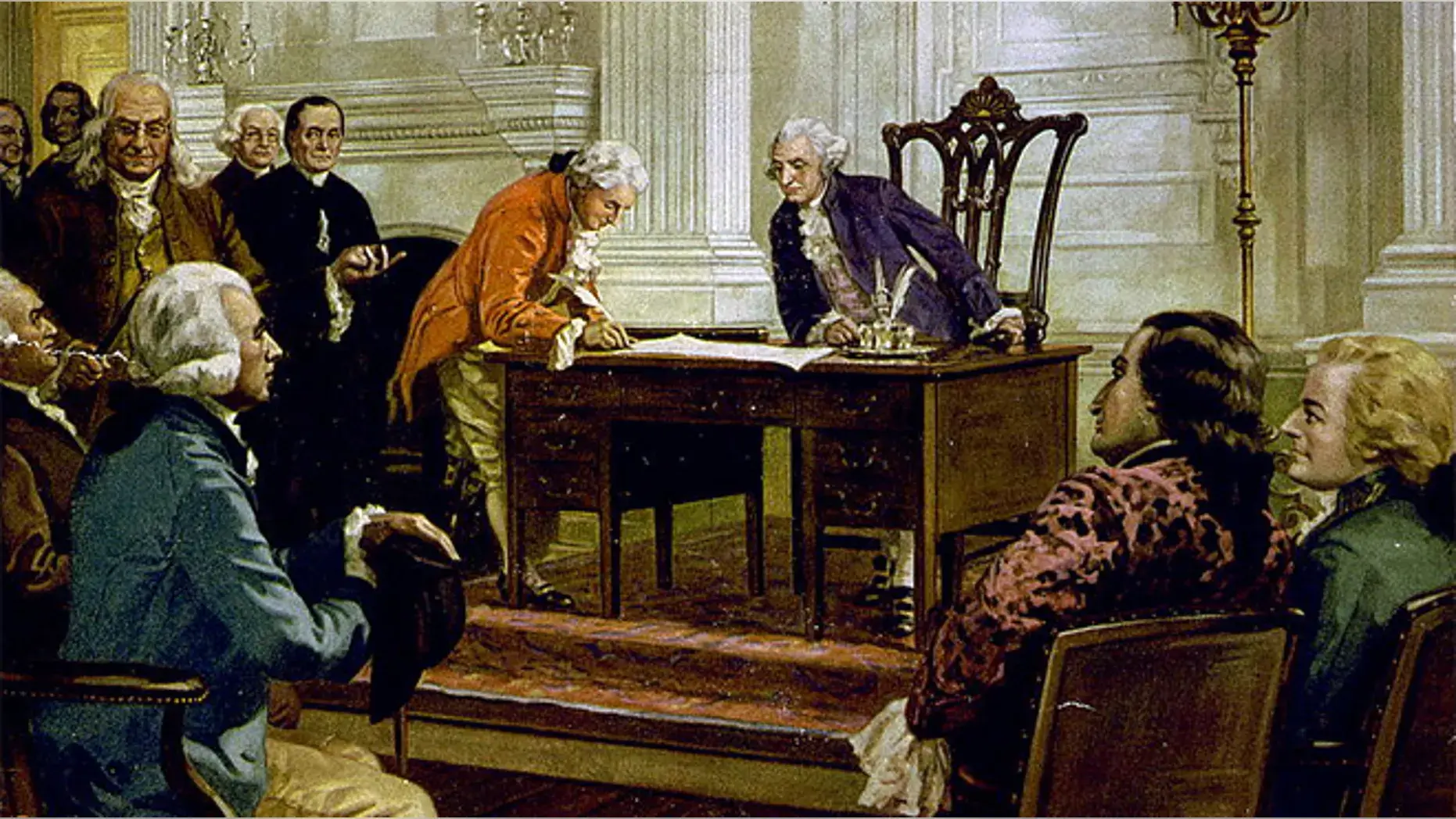
“The idea that the Constitution was really about money is not new, although it has lost favor in recent decades to “ideological” interpretations that focus on the Framers’ moral worldview and political goals.”
Matthew C. Simpson
The Founding Fathers’ Power Grab
It should go without saying that one of the goals of a “revolutionary” government is to prevent itself from being overthrown in a second revolution.
This is obvious. It is common sense.
The alternative would be to invite revolution or an overthrow of the new power by the former enemies or new opposition forces. Reasonable people would, therefore, conclude that the founders of the United States included measures and principles in the Constitution that were, in and of themselves, anti-revolutionary.
For example, when we analyze any new government, we could do so with the following questions in mind:
- What institutional power was overthrown?
- What new institutional power has assumed control?
- Which opposition forces does the new government prevent from taking “too much” political power?
We can use the French Revolution and the Russian October Revolution as case studies.
The French Revolution
In the long, violent period we call the French Revolution, several attempts were made at reforming the existing government which eventually deteriorated into open conflict and the assumption of Napoleon as emperor of France.
The initial constitution of 1791 sought to curtail the powers of the monarchy which was retained. According to historians, “The constitution was not egalitarian by today’s standards. It distinguished between the propertied active citizens and the poorer passive citizens.”
After that constitution fell short of expectations, a more radical constitution of 1793 (Constitution of Year I) was drafted, but was never implemented due to strong resistance from the landed gentry, rich landowners, and royalists.
The Constitution of Year III, which was implemented, was far more “liberal, moderate, and outright favorable to the bourgeoisie than the Constitution of Year I.
France succeeded in overthrowing the power of the royal family and the Catholic Church, with strong bourgeoisie groups taking control of the country and the legislative process. Groups like the Jacobins were emblematic of the struggle of the rich against the working class.
Radical groups failed to make headway against the better-organized and better-financed Jacobins, and the Jacobins and their allies failed to protect their gains against counter-revolution, leading to the creation of the French Empire under Bonaparte.
The Russian October Revolution
In the surprising October Revolution, Communist and working-class forces, led by the Bolsheviks, overthrew the liberal and capitalist provisional government that had controlled the country since the removal of Tsar Nicholas II in February of that year.
The Bolsheviks quickly instituted socialist and Communist laws, institutions, and principles based primarily on the writings of Lenin and Stalin, consolidating power in the hands of the Soviets (workers councils) throughout the country.
This consolidation helped protect the new Soviet Union when Western forces invaded Russia in an attempt to restore more western-friendly people to power. The United Kingdom, France, Italy, the United States, and Japan all invaded the new Union, resulting in the deaths of around five million people.
In the period after the “Civil War”, the Soviet Union set to work creating the structure of the new society and protecting the new socialist government from another counter-revolution. This led to the drafting of the 1936 constitution, which was written by a special commission of 31 people after reviewing thousands of proposals, ideas, and needs from across the Soviet Union.
The new government guaranteed the representation of workers’ councils through the Soviets, which meant that rich, outside forces could not overpower worker representation.
And, where the French constitutions defined who could and could not vote, often excluding the poor, women, and immigrants, the 1936 Constitution of the Soviet Union guaranteed the right to vote for everyone regardless of gender, race, or wealth. (Many members of the existing government argued strongly for excluding rich capitalists, landowners, and businessmen from voting, especially since these people had openly fought against them in the revolution and funded sabotage schemes and violent resistance; but Stalin himself had advocated for universal suffrage).
With this in mind, can we answer the question of how the “founding fathers” of the United States secured their revolutionary government against future revolutions?
I believe we can. But first, I think we need to address one of the many elephants in the room. That is the language of the American War of Independence.
The Propaganda of The American War of Independence

Jimmy Dore said, “Americans are the most propagandized people in the world.” And we can see the beginning of this truth from even before the founding of the country itself.
We must remember that most of the figures we revere in the United States were professional (or at least, very experienced) propagandists. This is not necessarily a bad thing, as print media was catching on, it is natural for interested forces to invest in material and tactics that would support their side.
Benjamin Franklin set up his own publishing house and was the publisher of the Pennsylvania Gazette, and he was not shy about using it to agitate for his personal politics. He published the first German-language newspaper in North America (Die Philadelphische Zeitung), published a number of religious texts, and much more. He often accused Blacks and other minorities of “weakening the social structure of the colonies”.
According to historian Ralph Frasca, Franklin used his printing facilities as “a device to instruct colonial Americans in moral virtue” and “saw himself as uniquely qualified to instruct Americans in morality. He tried to influence American moral life through the construction of a printing network based on a chain of partnerships from the Carolinas to New England. He thereby invented the first newspaper chain.”
According to Ed Crews, “He provided an early response to British surveillance through his own network of counter-surveillance and manipulation. He waged a public relations campaign, secured secret aid, played a role in privateering expeditions, and churned out effective and inflammatory propaganda.”
Alexander Hamilton had a long history of supporting a strong central government and using military force to suppress poor people and workers’ protests, particularly when it came to protecting the interests of the rich landowners.
During the constitutional convention, Hamilton made speeches proposing a president-for-life and proposed that elected senators would serve for life. James Madison said that Hamilton’s proposal was “claiming power for the rich and well born”.
Along with John Jay and James Madison, Hamilton wrote The Federalist Papers which have become nigh-religious texts among American conservatives. As the only remaining representative from New York, it should say a lot that he eventually ratified the constitution.
Other founding fathers (including Jefferson and Madison) criticized Hamilton for being “too oriented toward cities, industry and banking.”
During the Whiskey Rebellion, Hamilton started publishing essays under a new name of “Tully” in several Philadelphia newspapers. In these essays he strongly criticized and denounced the resistance to the Whiskey Tax by poor workers and advocated for military action.
Thomas Jefferson, on the other hand, is an entirely different beast.
As the primary author of the Declaration of Independence, Jefferson set the tone for what would become Americanism for centuries. It is no secret that he was deeply inspired by Locke and Montesquieu, among other French enlightenment thinkers, and was heavily influenced by Enlightenment ideals, the “sanctity of the individual”, and more.
In his autobiography, Jefferson promoted the idea of “the aristocracy of virtue and talent, which nature has wisely provided for the direction of the interests of society, & scattered with equal hand through all its conditions, was deemed essential to a well-ordered republic”.
Given his love for French ideals and that he was openly advocating for rebellion, historians argue that Jefferson intentionally wrote the declaration as a “love letter” to French Enlightenment thought that were growing in power in Europe in the hopes that it would persuade France to join the colonies when war inevitably broke out with Britain.
For such an important and impactful document, it is interesting that no minutes were kept during its drafting.
The more we learn about Jefferson, the more it becomes increasingly clear that much of what he wrote during this time was not really meant for American audiences. At least, not as a primary audience, anyway. I would argue that we can safely ignore almost everything Jefferson ever wrote when it comes to practical applications of his ideas. Only the most zealous ideologues take what he said and wrote at face value.
Why does this matter?
Well, naturally those who had the means and motive to influence the American people to think and act a certain way, did so. In their own way, our founding fathers framed the conflict between Great Britain and the colonies, and eventually the resulting war, in a certain way.
That way was as a revolutionary struggle. A struggle for human rights, for liberty, freedom, for religious principles, against an empire that refused to protect or guarantee those rights, and so on. There are few things that can motivate human being better than those.
That framing continues today.
Just look at this line from the Wikipedia article on the War of Independence:
“The American Revolution ended an age—an age of monarchy. And, it began a new age—an age of freedom.”
There are no references, no sources, no facts for this line. It is simply stated as though it were objective truth.
Or, take this paragraph from an article published by a conservative education website:
“As a result of the growing wave started by the Revolution, there are now more people around the world living in freedom than ever before, both in absolute numbers and as a percentage of the world’s population”
Not only is this factually untrue in several ways, it also does not provide any sources or references to back up this claim.
It is simply “truth”.
There has been some pushback against this “truth”, mostly led by those who learned very quickly that the propaganda surrounding the birth of our nation was false and based on falsehoods, namely Black people, immigrants, the poor and working class, and others.
For example, there has been a concerted effort by serious historians in recent decades to refer to the conflict using its more correct name: The American War of Independence, replacing the incorrect, propaganda title: The Revolutionary War.
Note:
This goes beyond the definition of the word “revolution”, by the way. While some people at the time used this word to define the conflict, it has a drastically different meaning today and its definition changes depending on its use. You will see it used throughout this piece, and in quoted material, with perhaps contradictory applications. I use the term loosely.
So, why does this matter? Well, the better we understand the origins of something, be better we can analyze and navigate our world of today. We can see similar tactics and language and how they are being used to manipulate people. We can identify cultural trends and more accurately predict where they will lead.
To believe that what we have been told about the War of Independence is free and untainted by bias and selfish motivations is foolish.
A society that is entirely blinded by such strong propaganda could never hope to evolve beyond a society of sheep.
Analysis of the War of Independence

Before we get into how the founders prevented future revolution, we must look at the War of Independence that necessitated a new constitution in the first place.
I begin this analysis with a selection from Daniel Boorstin’s work, The Genius of American Politics.
“The most obvious peculiarity of our American Revolution is that, in the modern European sense of the word, it was hardly a revolution at all. The Daughters of the American Revolution, who have been understandably sensitive on this subject, have always insisted in their literature that the American Revolution was no revolution but merely a colonial rebellion. The more I have looked into the subject, the more convinced I have become of the wisdom of their naivete. ‘The social condition and the Constitution of the Americans are democratic,’ De Tocqueville observed about a hundred years ago. ‘But they have not had a democratic revolution.’ This fact is surely one of the more important of our history…
“The American Revolution was in a very special way conceived as both a vindication of the British past and an affirmation of an American future. The British past was contained in ancient and living institutions rather than in doctrines; and the American future was never to be contained in a theory.”
Danniel Boorstin
The Genius of American Politics
The fact that the instigators of the war never intended to change the structure of society, but merely change who benefited from the existing structure, is made all the more clear with the analysis provided by Russell Kirk.
“The American Revolution did not result promptly in the creation of a new social order, nor did the leaders in that series of movements intend that the new nation should break with the conventions, the moral convictions, and the major institutions (except monarchy) out of which America had arisen…
The English Revolution and the French Revolution were contrary impulses—although for a brief while, with the summoning of the long dormant Three Estates, it had appeared that the French movement might be in part a turning back to old political ways as well.
In America, the dominant Federalists—and soon not the Federalists only—were similarly perplexed by that word. Here they stood, the victors of the American Revolution—Washington and Hamilton and Adams and Madison and Morris and all that breed—aghast at the revolution running its course in France. They had fought to secure the “chartered rights of Englishmen” in America, those rights of the Bill of Rights of 1689; and now they were horrified by the consequences of the Declaration of the Rights of Man. The same revulsion soon spread to many of the Jeffersonian faction—to such early egalitarians as Randolph of Roanoke, Republican leader of the House of Representatives. It spread in England to the New Whigs, so that even Charles James Fox, by 1794, would declare, “I can hardly frame to myself the condition of a people, in which I would not rather desire that they should continue, than fly to arms, and seek redress through the unknown miseries of a revolution.” In short, Whig revolution meant recovery of what was being lost; Jacobin revolution meant destruction of the fabric of society. The confounding of those two quite inconsonant interpretations of the word revolution troubles us still…
THE THESIS that the Patriots of 1776 intended no radical break with the past—that they thought of themselves as conservators rather than as innovators—is now dominant among leading historians of American politics.
Men like Bland—and those, too, like Patrick Henry, more radical than Bland—regarded themselves as the defenders of a venerable constitution, not as marchers in the dawn of a Brave New World…
The men who made the American Revolution, in fine, had little intention of making a revolution in the sense of a reconstitution of society. Until little choice remained to them, they were anything but enthusiasts even for separation from Britain.
The history of this slippery word revolution is a case in point. Political terms have historical origins. If one is ignorant of those historical origins—if even powerful statesmen are ignorant of them—great errors become possible. It is as if one were to confound the word law as a term of jurisprudence with the word law as a term of natural science. If one assumes that the word revolution signifies always the same phenomenon, regardless of historical background, one may make miscalculations with grave consequences—perhaps fatal consequences.
The American Revolution, or War of Independence, was a preventive movement, intended to preserve an old constitutional structure. Its limited objectives attained, order was restored. It arose from causes intimately bound up with the colonial experience and the British Constitution, and little connected with the causes of the French Revolution. In intention, at least, it was a revolution in the meaning of that term generally accepted during the seventeenth century and the first half of the eighteenth century.
A considerable element of the population of these United States has tended to fancy, almost from the inception of the Republic, that all revolutions everywhere somehow are emulatory of the American War of Independence and ought to lead to similar democratic institutions. Revolutionary ideologues in many lands have played successfully enough upon this American naivete. This widespread American illusion, or confusion about the word revolution, has led not merely to sentimentality in policy regarding virulent Marxist or nationalistic movements in their earlier stages, but also to unfounded expectations that by some magic, overnight “democratic reforms”—free elections especially—can suffice to restrain what Burke called “an armed doctrine.” How many Americans forget, or never knew, that in time of civil war Abraham Lincoln found it necessary to suspend writs of habeas corpus?
The Constitution’s Framers, in 1787, wanted no more revolutions; and President Washington, in 1789 and after, set his face against the French revolutionaries.”
Russell Kirk
A Revolution Not Made, but Prevented
An essay published in the collection Rights and Duties
If we actually sit and think about the impact of the American War of Independence, the more this makes sense. There really was no new social order after the war, no new values imposed on society, no new rights that the people won. It was mostly a shakeup of what rules and orders already existed.
Most of all, however, it was a struggle of the American aristocracy and rising capitalists against the control (and the extraction of money) by the British government. In the few rare glimpses we get into the motivations of the founding fathers, we see some pretty material, human motivations. As this example with Benjamin Franklin shows:
“The question with them was not whether they were to remain as they had been before the troubles, for better, he allowed, they could not hope to be; but whether they were to give up so happy a situation without a struggle? Mr. Burke had several other conversations with [Benjamin Franklin] about that time, in none of which, soured and exasperated as his mind certainly was, did he discover any other wish in favour of America than for a security to its ancient condition.”
Burke
Appeal from the New to the Old Whigs
When we look at the War of Independence the same way we look at other wars throughout history and in other parts of the world, untainted by propaganda and patriotism, and consider all the work these men conducted before the war and include their very tangible financial and physical motivations, the economic forces that led to the outbreak of war become clear, and the war takes on a much more real, less idealistic (less divinely-inspired), character. As Holton explains:
“Nearly all of the best-known Founding Fathers—from Thomas Jefferson and George Washington in Virginia to Benjamin Franklin and Robert Morris in Pennsylvania and Henry Knox and Abigail (not John!) Adams in Massachusetts—dreamed of vastly enhancing their wealth by speculating in western land. That meant obtaining large grants directly from the government, essentially for free, and then dividing them into smaller tracts to be sold to actual settlers. But in October 1763, the Privy Council in London took out a map of North America and drew a line along the crest of the Alleghany Mountains. Beyond that line, the ministers declared, no colonist would be permitted to settle.
At first George Washington was confident that the Proclamation Line was only a “temporary expedient” that would soon be repealed. But the British government stood by the 1763 decree for the same reason that it had been promulgated in the first place: in order (as Washington put it) “to quiet the minds of the Indians.” It was not sympathy for the American Indians’ plight that had motivated the Privy Council to turn the area west of the Alleghanies into a giant reservation. Nor was it fear, since of course British officials were in no danger. The issue was financial. Earlier in 1763, more than a dozen Native American nations had joined together in a coalition dedicated to preserving their land. The ensuing revolt is popularly known as Pontiac’s Rebellion, though that label understates the range of the insurgency and exaggerates the role of a single Ottawa headman in a movement where leadership was actually quite dispersed.
If the Indians of present-day Ohio, Indiana, Illinois, and Michigan had not decided to rebel in 1763, the Privy Council might never have drawn the Proclamation Line, and land speculators like Washington and Jefferson would have had one less reason to rebel against Great Britain. The Declaration of Independence mentions the well-known issue of taxation once—and Indians and their land three times.
In 1769, the Virginia House of Burgesses (whose members included Thomas Jefferson and George Washington) unanimously adopted a resolution asking the Privy Council to repeal the Proclamation of 1763. British officials never acted on the request, and one reason was their abiding concern that taking the Indians’ land would provoke renewed hostilities. Lord Hillsborough, George III’s secretary for his American dominions, was determined to keep Britain out of a “general Indian War, the expense whereof will fall on this kingdom.” The imperial government’s ensuing decision to thwart the land-hungry provincials had the ironic effect of paving the way for an even more expensive war against a coalition of colonists.”
Woody Holton
Unruly Americans in the Revolution
To ignore the economic forces before and during the time of the War of Independence is to willfully remain ignorant of the forces that created our society today and continue to influence our society into the future.
“It is not to the Declaration we should look, if we seek to understand the motives of the men who accomplished the American Revolution: not, at least, to the Declaration’s first two paragraphs. It is my view that the major issue of the American Revolution was the true constitution of the British Empire, which is a pretty technical legal problem.”
Daniel Boorstin
Critique of the Constitution – The 1 Percent’s Revenge
“The Constitution was a conservative counterrevolution against what leading American statesmen regarded as the irresponsible economic measures enacted by a majority of state legislatures in the mid-1780s… the Constitution was designed in part to block legislation for tax and debt relief.”

Michael J. Klarman
The Framers’ Coup: The Making of the United States Constitution
After the founders of our nation had kicked out the monarchy, it was time to secure their own positions of power. This task they set for themselves was not easy. They had to balance the interests of the different colonies, secure their power and economic interests, prevent future revolution, dissuade European powers from seeking to capitalize on the new power vacuum, and build a government that could survive contemporary and future crises.
Scholar Matthew C. Simpson describes the context and impact of the constitution thusly:
“The proposed government was less democratic than either the Articles of Confederation or the individual state constitutions… anti-Federalists (those who opposed the Constitution) had good reason to argue that its true purpose was, as one of them put it, the “transfer of power from the many to the few.” The democratic impulses of the Revolutionary Era now came to bear in opposition to the Constitution, both in the press and at the ratifying conventions…
The Constitution is undemocratic because it was designed to protect wealthy merchants and landowners from the redistributive tendencies of popular government.
During the period after the Revolutionary War most state constitutions were highly democratic, at least for the era. At the same time, the country was suffering a post-war financial crisis that was ruinous to artisans and small farmers. Not surprisingly, common people began to use their new political influence to create economic policies that were favorable to themselves (and disadvantageous to creditors and wealthy citizens), such as inflationary monetary policy and progressive taxation. The Constitution, according to the economic interpretation, was the 1 percent’s revenge, a countermeasure designed to undermine the democratic governments in the states, thereby returning power to wealthy elites and insulating them from popular opinion.
Nearly every clause of the Constitution was written and rewritten in fear of losing the support of slave-holding interests… in obvious points like the Three-Fifths Compromise and Fugitive Slave Clause and in less obvious such as the Electoral College, which gave slave states a larger say in electing the president that their voting population alone would have warranted…
By the late-1780s it had become conventional wisdom among political elites that, as Elbridge Gerry put it, “the evils we experience flow from an excess of democracy.” The Constitution was designed to reverse the democratic trajectory of American politics…
A primary goal of the Constitution was, in Klarman’s words, “to constrain the influence of public opinion upon government.”
The question for [Thomas Jefferson] was not whether the Constitution was too aristocratic—it was—but whether that was a price worth paying to save the union.”
Matthew C. Simpson
The Founding Fathers’ Power Grab
According to a New York University Law Review study published in 2012 by David Law and Mila Versteeg, “the U.S. Constitution guarantees relatively few rights compared to the constitutions of other countries and contains fewer than half (26 of 60) of the provisions listed in the average bill of rights.”
Many of those responsible for creating and ratifying the constitution were not particularly pleased with the final document. According to several historians, “Several of the delegates were disappointed in the result, a makeshift series of unfortunate compromises. Some delegates left before the ceremony and three others refused to sign.”
Benjamin Franklin even said in front of the whole convention: “There are several parts of this Constitution which I do not at present approve, but I am not sure I shall never approve them.” He would accept the Constitution, “because I expect no better…”
Some delegates refused to accept it unless a bill of rights was added, and here we must address the process of amending the constitution.
I remember being taught as a child that the fact the constitution is so difficult to amend was an intentional choice to prevent “fringe” or “radical” groups from making changes to the divinely-inspired text. That only an overwhelming majority of the population could make a change, which would mean it was a universal good… or a sign of the end times.
It was never even hinted at that it is so difficult to amend, perhaps, because those who wrote it wanted to ensure their hard-won spoils remained in their hands and could not be taken away by amendment.
Steven Levitsky and Daniel Ziblatt wrote in 2023 that “the US Constitution is the most difficult in the world to amend, and that this helps explain why the US still has so many undemocratic institutions that most or all other democracies have reformed, directly allowing significant democratic backsliding in the United States.” (Source: Tyranny of the Minority: why American democracy reached the breaking point).
“Free white men were the clearest winners of the American Revolution, but for the vast majority of freemen, these gains were modest at best. Historians have shown that, especially after the adoption of the US Constitution in 1789, ordinary farmers actually lost ground in some important areas. For instance, control over the money supply—which determined whether debtors gained at the expense of creditors or vice versa—passed from the colonial assemblies, many of which had been elected annually, to a federal government that often seemed beyond the reach of common plowmen.”
Woody Holton
Unruly Americans in the Revolution
Whether the constitution is an effective government document is an entirely separate question from whether it actually embodies and reflects the values the founding fathers said they were fighting for during the War of Independence.
It does not.
As Jefferson said:
“It must be agreed that our governments have much less of republicanism than ought to have been expected; in other words, that the people have less regular control over their agents, than their rights and their interests require.”
What words best describe the constitution, then? There is no shortage of adjectives that have been applied to this document since the very moment it was written.
On the one side, we have words like inspired (even divinely so), revolutionary, daring, bold, visionary, and sometimes even sacred. Yet these words are obviously and blatantly wrapped in nationalism, puritan Christian philosophy, and even white supremacy, with obvious motives to use the founding document to support current power structures.
On the other hand, we have words like evil, oppressive, racist, greedy, and other words that assign motive to people who show plenty of signs of being genuine in their pursuit of progress or even progressive in some areas. They also seek to assign blame for current situations that have their roots beyond the drafting of the constitution. In other words, they make a scapegoat of the constitution and its writers.
What better word could there be, or what better summary of the intent and result of the constitution is there than:
Anti-revolutionary?
In the end, the delegates that were sent to New York with an explicit mandate to update and revise the articles of confederation, instead came back to their respective colonies with a proposal for an entirely new form of government, a new country with fewer rights for the citizens, more power for the wealthy and elite, and an open threat to ratify it.
Only a majority of the colonies were required to ratify the constitution in order for the new government to be established. Meaning that even if a colony refused to sign, if a majority approved it, that majority would consider all others a part of their new country.
Some colonies were reluctant to ratify the new constitution for many of the reasons listed above. Rhode Island even refused to ratify it at all until the new United States threatened to embargo it.
This opinion of the American aristocracy toward the idea of democracy was stated pretty clearly by the Pennsylvania physician Benjamin Rush during the process of ratification:
“What is the present moral character of the citizens of the United States? I need not describe it… Nothing but a vigorous and efficient government can prevent their degenerating into savages. Democracy is the devil’s own government.”
The Constitution’s Proof

Just two years after the new U.S. government was established and the constitution was put to work, President Washington passed the “Whiskey Tax” in order to pay the bills “for a war that mostly benefited the wealthy landowners of the East.” This tax targeted farmers and distillers in the West.
Historian William Hogeland describes the situation. The Whiskey Tax was:
“A clear backtrack from the rallying cry “no taxation without representation” and the first opportunity for Americans to learn the difference between what politicians say and what they mean.
Hamilton’s excise effectively gave unfair tax breaks to large distillers, most of whom were based in the east.
Cash, which at this time consisted of specie (gold and silver coins), was always in short supply on the frontier, nevertheless the law explicitly stipulated the tax could only be paid in specie. In lieu of specie, whiskey often served as a medium of exchange, which for poorer people who were paid in whiskey meant the excise was essentially an income tax that wealthier easterners did not have to pay
Hamilton’s excise effectively gave unfair tax breaks to large distillers, most of whom were based in the east.”
William Hogeland
The Whiskey Rebellion
As though to reinforce the point that the tax was meant to enrich the already wealthy landowners and capitalists in the East, most of the tax collectors were themselves business owners who benefited from the tax.
“Federal tax inspector for western Pennsylvania General John Neville was determined to enforce the excise law. He was a prominent politician and wealthy planter—and also a large-scale distiller. He had initially opposed the whiskey tax, but subsequently changed his mind, a reversal that angered some western Pennsylvanians.”
Thomas P. Slaughter
The Whiskey Rebellion: Frontier Epilogue to the American Revolution
Hamilton and Washington ignored and blatantly flaunted the new “rights” they had just fought a war to gain and enshrine in a new constitution. Rights like due process, habeas corpus, and others were dismissed as they sent federal troops to “carry out raids on the night of November 13, breaking into houses and rousing suspects from their beds. No distinction was made between rebels and witnesses. Captives were driven, in their nightclothes and barefoot, over muddy roads and streams, to be held in floorless animal pens and basements. Some had their health ruined, and at least one died.”
As always, actions speak louder than words. Whatever these men said they were fighting for or what their dreams were for our country, we should judge their character — and their legacy — based on what they did. We should judge a tree based on its fruits.
The fruits that first began to grow during the Whiskey Rebellion continued to grow over the decades and have grown fat and rotten.
The Fruits of the Constitution

We are citizens of the most violent country in the history of humankind, and ruled by the beneficiaries, and perpetrators, of the greatest wealth disparity of recorded memory.
According to James A. Lucas of Global Research, the U.S. has directly killed 20–30 million people since the conclusion of World War II. This includes “10 to 15 million deaths during the Korean and Vietnam Wars and the two Iraq Wars” and “between nine and 14 million deaths in Afghanistan, Angola, Democratic Republic of the Congo, East Timor, Guatemala, Indonesia, Pakistan and Sudan.” In total, the U.S. has killed millions of people in more than 37 countries since WWII.
This does not include secondary deaths caused by starvation, displacement, murder by U.S.-funded groups, deaths by slave labor or poisoning by U.S. corporations, or killings by puppet regimes controlled by the U.S.
In light of these data, Lucas poses the following question: “How many September 11ths has the United States caused in other nations since WWII? The answer is: possibly 10,000.”
Author and historian David Michael Smith has calculated an even higher number:
“The U.S. empire is responsible, or shares responsibility, for close to 300 million deaths… the almost inconceivable loss of life in these endless holocausts arguably makes this country [the United States] exceptional, though in a strikingly different way than its apologists intend.”
David Michael Smith
Endless Holocausts: Mass Death in the History of the United States Empire
This includes:
- 13 million killed during the Indigenous Peoples’ Holocaust
- 32.5 million in the African American Holocaust. (Between the years 2000 and 2014 alone, another one million excess deaths occurred among Blacks because of the racist police and criminal justice system and poor living conditions.
- 13.5 million workers have died in the U.S. or outside working for U.S. corporations from disease, sickness or in anti-labor massacres. (35,000 workers died on the job annually between 1880 and 1900—700,000 for those two decades alone as Congress refused to pass basic regulations to protect workers’ rights).
- One million Filipinos killed resisting the U.S. colonial war in the Philippines (including 1,000 Filipino Muslims, known as Moros, who were massacred taking refuge at Bud Dajo).
- Two million in the Vietnam “war”.
The U.S. also shares responsibility for the deaths during WWII because:
“In the 1930s, the U.S. supported fascist dictatorships as a counterweight to communism, including that of Benito Mussolini, Francisco Franco, and Adolf Hitler, whom the U.S. chargé d’affaires in Berlin, George Gordon, characterized in 1933 as the “leader of the moderate section of the Nazi party,” which “appealed to all civilized and reasonable people.
The U.S. provoked the war in the Pacific theater because it could not tolerate the prospect of an ascendant Japanese empire that would threaten U.S. hegemonic aspirations in Southeast Asia.
Between 1775 and 1945, when it succeeded in replacing Great Britain as the dominant world power, the U.S. caused 127 million deaths. These included the hundreds of thousands of Japanese who were killed as a result of the Tokyo firebombing and dropping of the two atomic bombs over Hiroshima and Nagasaki, which killed well over 200,000 people in the span of a few days.”
(Summary of Smith by Jeremy Kuzmarov)
The American aristocracy and businesses profited immensely from the Nazi rise to power before WWII (due to the privatization of huge swaths of the German economy and abolishing of workers’ rights) and those profits skyrocketed after war broke out as Germany plundered the continent which was only possible with the support of U.S. money, banks, and manufacturing.
This is beside the fact that U.S. leadership opposed intervening militarily in Europe and delayed the D-day landings in the hope that the Germans and Soviets would kill each other and Germany would be content with its current conquests.
U.S. forces were also instructed to avoid damaging or bombing the facilities owned by U.S. corporations (like Ford or GM) even though they were actively producing weapons and ammunition for Germany. At the same time, U.S. politicians and banks were openly funding Nazi operations, facilitating and benefiting from the slave labor in concentration camps, and helping German aristocrats and Nazi leadership smuggle gold and money out of Europe.
At least one million Koreans.
“Just five years after the end of World War II, the U.S. was again at war in Korea where it supported a government that slaughtered over one hundred thousand of its own people, and carried out a bombing campaign that led to the death of about one tenth of the North Korean population.
Further, U.S. troops committed a multitude of massacres, including at No Gun Ri, where several hundred civilians were killed after orders had been given to shoot at North Korean refugees who represented potential “fifth columnists.”
The Korean War was a prelude to further slaughter in Vietnam where the “mere gook rule” applied, by which civilians were mowed down under the justification that they ‘Looked like they were Vietcong’.”
(Kuzmarov)
Millions of Indonesians.
“In 1965, the CIA backed a coup in Indonesia that resulted in the deaths of millions of alleged communists who were identified by lists provided to the Indonesian military by the CIA. One person suspected of helping to identify names for the blacklist was Ann Dunham, Barack Obama’s mother, who worked as an anthropologist in East Java, a communist stronghold.”
(Kuzmarov)
The list goes on. I am not going to even begin to explore Operation Condor, Operation Phoenix, the War on Drugs, the War on Terror, the numerous Israeli crimes funded and enabled by the U.S., and others.
“Even under a supposedly liberal president, Barack Obama, the U.S. bombed seven Muslim countries, escalated its troop presence in Afghanistan, established many new military bases in Africa, and engaged in regime-change operations in several Latin American countries…
The U.S. is among the most violent societies in history—with disturbingly high homicide, police murder and incarceration rates—and faces the threat of right-wing militias and terrorists.”
With the exception of slavery and the genocide against Native Americans, the endless holocausts associated with the American empire are rarely discussed in high school or even college courses, and are not very well known by the public—despite a rich scholarly literature about them.
This is because the public has been fed a steady diet of propaganda and bad revisionist history—like that advanced by the Victims of Communism Museum—which demonize left-wing ideologies and try to validate the “American way.”
If more people knew the truth, a strong resistance movement to U.S. imperialism might develop that could draw on the precedent of the early 20th century Anti-Imperialist League—supported by such luminaries as Mark Twain.
Until that time… the succession of catastrophes “will continue… and as its primacy erodes, the U.S. ruling class may act like a ‘wounded beast’ and commit heinous new crimes against the peoples of the world—including the people of this country—to maintain as much wealth and power as possible.”
(Kuzmarov)
According to CIA whistleblower John Stockwell, as of 1987 the CIA alone was directly responsible for the deaths of six million people. This includes “one million killed in the Korean War, two million killed in the Vietnam War, 800,000 killed in Indonesia, one million in Cambodia, 20,000 killed in Angola… and 22,000 killed in Nicaragua. These people would not have died if U.S. tax dollars had not been spent by the CIA to inflame tensions, finance covert political and military activities and destabilize societies.”
Additionally, between 2010 and 2021, economic sanctions imposed by the U.S. on other countries are responsible for an estimated 564,258 deaths every year, according to a report by The Lancet. The authors of the study say, “All economic sanctions ultimately function as sanctions on health… Deaths of children younger than 5 years represented 51% of total deaths caused by sanctions over the 1970-2021 period.”
These deaths continue.
A piece by the People’s Dispatch also reported on these findings:
“The unilateral coercive measures imposed on Venezuela have taken a devastating toll on most of the population, constituting an act of collective punishment and thus a crime against humanity… Vaccination campaigns were disrupted by the inability to obtain specific components, increasing health risks for children in situations that could have been entirely preventable… The most notable and outrageous case was that of COVID-19 vaccines, which Venezuela was not allowed to purchase using public funds held in its illegally frozen foreign accounts. At the onset of the pandemic, Venezuela could have easily bought all the vaccines needed for its entire population from these accounts, some of which remain frozen to this day.”
Carlos Ron
Former Vice Minister of Foreign Affairs for North America
The tyranny is not limited to our military and political oppression and exploitation of foreign nation, of course.
According to prisonpolicy.org:
- Behind El Salvador, nine U.S. states have the next highest incarceration rates in the world
- Massachusetts, the state with the lowest incarceration rate in the nation, would rank 30th in the world with an incarceration rate higher than Iran, Colombia, and all the founding NATO nations.
- In fact, many of the countries that rank alongside the least punitive U.S. states, such as Turkmenistan, Belarus, Russia, and Azerbaijan, have authoritarian or dictatorial governments, but the U.S. — the land of the free — still incarcerates more people per capita than almost every other nation. Importantly, high incarceration rates have little impact on violence and crime.
We have the largest prison population not only in the world, but in the history of humanity, with a higher prison population than even China that has 1.5 billion citizens. The prison industrial complex of the United States, a system run for-profit, has resulted in one of the longest continual systems of forced and slave labor in the world and is guilty of numerous human rights abuses and crimes against humanity.
A U.N. report concluded that U.S. prisons showed “shocking violations of basic human rights”. It also said the “U.S. is the only country in the world that sentences children to life without parole,” and concluded that “the prison system is a free Black workforce”.
A 2024 document reported “blatant racism, child slave labor, and pregnant women giving birth in shackles…” and inmates “freezing without blankets, covering themselves with plastic bags to stay warm, going hungry, denied prescribed medications, suffering delusions and stuck in dirty living quarters.”
According to independent reporters, the “systemic racism of the US police and courts maintains a legacy of slavery” that “continues to exist in the form of racial profiling, police killings and many other human rights violations.”
In 2022, the University of Chicago published an article that reported “Incarcerated workers generate billions of dollars’ worth of goods and services annually but are paid pennies per hour without proper training or opportunity to build skills for careers after release.”
“We reject the ‘bad apple’ theory. There is strong evidence suggesting that the abusive behaviour of some individual police officers is part of a broader and menacing pattern,”
Professor Juan Méndez
Human Rights Council
This reality is possible because of the constitution, not in spite of it. The working class, the poor, have less power in this country than in most other countries by design, and every year we see what little power we have further eroded.
This truth, this fundamental structure of our country will not change by using the tools given to us by the constitution like scraps from the table of democracy. It must be, and can only be, changed from outside the system.
As Smith predicts, until we come to grips with our history, take responsibility for our position in the world, and take action to stop it from continuing, our ruling class will continue to “commit heinous new crimes against the peoples of the world—including the people of this country—to maintain as much wealth and power as possible.”
I think it’s time we finally learn from our history and make a change.